

Understanding the Four German Cases
Why do Germans say “Ich frage dich” but “Ich antworte dir“?
One of the biggest surprises for German learners is that German nouns, articles, and pronouns can change their form depending on their role in the sentence.
For example:
- Ich frage dich. (I ask you.)
- Ich antworte dir. (I answer you.)
Why dich in one sentence, but dir in the other?
The answer is German cases — Kasus.
The verb fragen requires the Accusative, while antworten requires the Dative.
So:
fragen + Akkusativ → Ich frage dich.
antworten + Dativ → Ich antworte dir.
This is why understanding cases is so important in German.
What is a Case?
A case (Kasus) tells us what role a noun or pronoun has in a sentence. It can also be determined by certain verbs and prepositions.
German has four cases:
| Case | Main Question | Simple Memory Idea |
|---|---|---|
| Nominative (N) | Wer? / Was? | 🧑 The Doer |
| Accusative (A) | Wen? / Was? | 🎯 The Target |
| Dative (D) | Wem? | 🎁 The Receiver |
| Genitive (G) | Wessen? | 🔑 The Owner |
Here is one sentence containing all four cases:
Die Frau (N) gibt meinem Bruder (D) den Kuchen (A) ihrer Tochter (G).
Let’s break it down:
Who is doing the action?
→ Die Frau → Nominative
What is being given?
→ den Kuchen → Accusative
To whom is the cake being given?
→ meinem Bruder → Dative
Whose cake is it?
→ ihrer Tochter → Genitive
In English:
The woman gives my brother her daughter’s cake.
So we have:
- Die Frau → subject → Nominative
- meinem Bruder → indirect object → Dative
- den Kuchen → direct object → Accusative
- ihrer Tochter → possession → Genitive
Another example:
Der Trainer (N) gibt dem Spieler (D) den Ball (A) des Vereins (G).
The coach gives the player the club’s ball.
Why Are Cases Important?
You already know that German nouns usually have a grammatical gender and are often accompanied by an article:
- der
- die
- das
- die (plural)
But these articles do not always stay the same.
The case determines whether these articles stay the same or change.
The case can change the article:
der Mann → Ich sehe den Mann.
die Frau → Ich helfe der Frau.
das Kind → Das Spielzeug des Kindes.
Look at this table to see the Article changes:
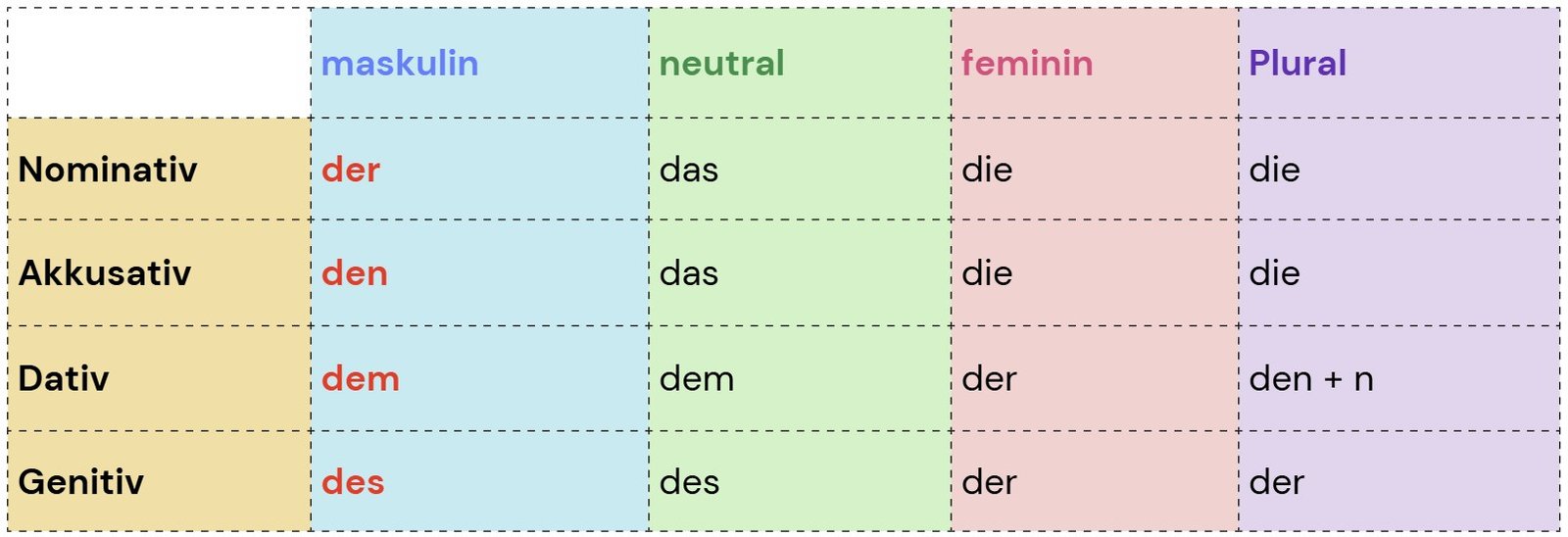
Understanding cases helps you choose the correct article, pronoun, adjective ending, and sentence structure.
A. Nominative
The Nominative is the subject of the sentence.
The subject is the person or thing performing the action.
It usually answers the questions:
- Who?
- What?
We use the Nominative when:
1. The noun is the subject.
Examples
Der Hund schläft.
The dog is sleeping.
Who is sleeping?
→ Der Hund
Therefore, der Hund is Nominative.
2. After certain verbs
Some verbs are best friends to NOMINATIV. These verbs always bring Nominativ case with them.
Common examples include:
- sein
- heißen
- bleiben
- werden
Examples
Er ist Lehrer.
Sie heißt Anna.
Das Wetter bleibt schön.
Sie wird Ärztin.
Article Changes
In the Nominative, the articles stay in their basic form.
| Masculine | Feminine | Neuter | Plural |
| der | die | das | die |
These are the basic forms you normally learn with German nouns.
B. Accusative
The Accusative is used for the direct object.
The direct object receives the action.
It usually answers:
- Whom?
- What?
- Sometimes Where to? (Wohin?)
We use the Accusative when:
1. The noun is the direct object.
Examples
Ich kaufe einen Computer.
What am I buying?
→ einen Computer (article ‘ein‘ change into → einen)
Notice what happens:
ein Computer → einen Computer
The masculine article changes.
2. After certain verbs (Akkusativverben)
Some verbs are best friends to AKKUSATIV. These verbs always bring Akkusativ friends with them.
Examples include:
- haben
- kaufen
- lesen
- hören
- sehen
- finden
- kennen
- mögen
- möchten
- wollen
- nehmen
- suchen
- machen
You have to learn and remember the verbs that are bestfriends to Akkusativ.
Click this link to get complete list of Akkusativverben. https://docs.google.com/spreadsheets/d/1GzK7aJRzdx8QMxVmrFgL4HMap1AcvJ2iTxAPUaI2eoc/edit?usp=sharing
3. After Accusative prepositions
Some prepositions always require the Accusative.
Common Accusative prepositions are:
- durch
- für
- gegen
- ohne
- um
Also commonly encountered:
- bis
- entlang
Remember:
The preposition is the boss! 👑
If you see für, you do not need to spend five minutes analyzing the sentence:
für → Akkusativ. Done!
For example:
Das Geschenk ist für meinen Bruder.
für requires Accusative, so:
mein Bruder → meinen Bruder
Accusative Articles
With the definite articles, only the masculine form changes:
| Masculine | Feminine | Neuter | Plural | |
| Nominative | der | die | das | die |
| Accusative | den | die | das | die |
Easy memory trick:
DER → DEN
C. Dative — The Receiver 🎁
The Dative (Dativ) is often used for the indirect object.
With verbs such as geben, schicken, zeigen or bringen, the Dative often identifies the person receiving something.
It commonly answers:
- Wem? — To whom?
With certain prepositions, it can also answer:
- Wo? — Where?
We use the Dative when:
1. The noun is the indirect object.
Example
Ich gebe dem Mann ein Buch.
What am I giving?
→ ein Buch → Accusative
To whom am I giving it?
→ dem Mann → Dative
Notice:
der Mann → dem Mann
2. After certain verbs (Dativverben)
Some verbs are best friends to DATIV. These verbs always bring Dativ case with them.
Common examples:
- helfen
- antworten
- gefallen
- gehören
- glauben
- gratulieren
- passen
- schmecken
- wehtun
- passieren
You must learn and remember all verbs that are best friends to Dativ, to be able to build a correct German sentence.
Click this link to get complete list of Dativverben. https://docs.google.com/spreadsheets/d/1GzK7aJRzdx8QMxVmrFgL4HMap1AcvJ2iTxAPUaI2eoc/edit?usp=sharing
For example:
Ich helfe dem Mann.
Das Buch gehört meiner Schwester.
Ich antworte dir.
And now we can solve our original mystery:
Ich frage dich.
fragen → Akkusativ
but:
Ich antworte dir.
antworten → Dativ
German verbs bring their case-friends with them!
So when learning a new verb, don’t learn only:
helfen = to help
Instead, learn:
jemandem helfen = to help someone → Dativ
That small habit can save you many mistakes later.
3. After Dative prepositions
These prepositions always require the Dative:
- aus
- bei
- mit
- nach
- seit
- von
- zu
- gegenüber
- ab
- außer
For example:
Ich fahre mit dem Bus.
Sie kommt aus der Schule.
Wir gehen zu einem Restaurant.
Again:
The preposition is the boss! 👑
If the preposition requires Dative, use the Dative.
⚠️ Achtung! Two-Way Prepositions
Some prepositions can take either Accusative or Dative.
They are called Wechselpräpositionen:
- an
- auf
- hinter
- in
- neben
- über
- unter
- vor
- zwischen
A useful beginner rule is:
WO? → Dativ
WOHIN? → Akkusativ
Compare: liegen (is located / lie) VS legen (to lay)
⚽ Der Ball liegt auf dem Tisch.
Wo liegt der Ball?
→ auf dem Tisch → Dative
But:
⚽ Tobias legt den Ball auf den Tisch.
Wohin legt Tobias den Ball?
→ auf den Tisch → Accusative
Memory trick:
WO? → location → Dativ
WOHIN? → destination / change of location → Akkusativ
Dative Article Changes
| Masculine | Feminine | Neuter | Plural | |
| Nominative | der | die | das | die |
| Dative | dem | der | dem | den |
There is one more important rule:
Dative Plural usually adds -n to the noun.
die Kinder → den Kindern
die Freunde → den Freunden
die Bücher → den Büchern
If the plural already ends in -n or -s, we normally do not add another -n.
die Frauen → mit den Frauen
die Autos → mit den Autos
D. Genitive — The Owner 🔑
The Genitive (Genitiv) mainly expresses possession, belonging, or a relationship between nouns.
It answers:
Wessen? — Whose?
We use the Genitive when:
1. Showing Possession
Das ist das Auto des Lehrers.
Whose car is it?
→ des Lehrers
Das Dach des Hauses ist neu.
Whose / which house’s roof?
→ des Hauses
In English, we often translate the German Genitive using ‘s or of.
2. After certain prepositions
Some prepositions require the Genitive.
Common examples include:
- wegen — because of
- trotz — despite
- während — during
- statt / anstatt — instead of
Examples:
Wegen des Regens bleiben wir zu Hause.
Trotz des schlechten Wetters gehen wir spazieren.
In everyday spoken German, many people use the Dative after these prepositions instead, especially after wegen. However, for learners, it is best to learn the standard pattern:
Examples
- Ich gehe nicht zur Arbeit wegen des Gewitters. (not common)
- Ich gehe nicht zur Arbeit wegen Gewitter. (common)
3. With geographical names
Countries without an article usually add -s.
Example
Deutschlands Hauptstadt ist Berlin.
Europas größte Volkswirtschaft
Countries with an article use the Genitive article instead.
Example
Die Hauptstadt der Türkei ist Ankara.
4. With people’s names
Most names simply add -s.
Examples
- Lisas Fahrrad
- Daniels Auto
Names ending in -s, -ss, -ß, -x, -z, or -tz use only an apostrophe.
Example
Iris‘ Hund
Max’ Fahrrad
Article Changes
| Nominative | Genitive |
| der | des |
| die | der |
| das | des |
| die | der |
Masculine and neuter nouns usually also add -s or -es:
der Mann → des Mannes
das Buch → des Buches
der Bus → des Busses
Many short, one-syllable nouns commonly use -es, although there are exceptions.
A Note About the Genitive
The Genitive is less common in everyday spoken German than it was in the past. In conversation, Germans often replace it with von + Dative.
For example:
das Auto meines Bruders
can also be expressed conversationally as:
das Auto von meinem Bruder
Both are correct, but von + Dative is more common in everyday speech.
Some verbs and adjectives also require the Genitive, but these are mainly found in formal or written German. In modern spoken German, many of these verbs are now used with a preposition instead.
🔎How Do I Know Which Case to Use?
When you are unsure, use these three steps:
Step 1 — Welche Rolle? 🧑🎯🎁🔑
Ask yourself:
Who is doing what to whom?
Can you identify the subject, object, receiver, or owner?
Step 2 — Welches Verb? 🔍
Check the verb.
Does the verb require a particular case?
sein + Nominativ
fragen + Akkusativ
helfen + Dativ
antworten + Dativ
Remember:
The verb brings its case-friend with it!
Step 3 — Welche Präposition? 👑
Look for a preposition.
Does it require a particular case?
für → Akkusativ
mit → Dativ
wegen → Genitiv
And remember:
The preposition is the boss!
If there is a preposition that requires a specific case, it determines the case of the noun or pronoun that follows it.
| Case | Identity | Main question | Memory idea |
|---|---|---|---|
| Nominativ | 🧑 The Doer | Wer?/Was? | Who does it? |
| Akkusativ | 🎯 The Target | Wen?/Was? | What/who receives the action? |
| Dativ | 🎁 The Receiver | Wem? | To whom? |
| Genitiv | 🔑 The Owner | Wessen? | Whose? |
0 Comments