
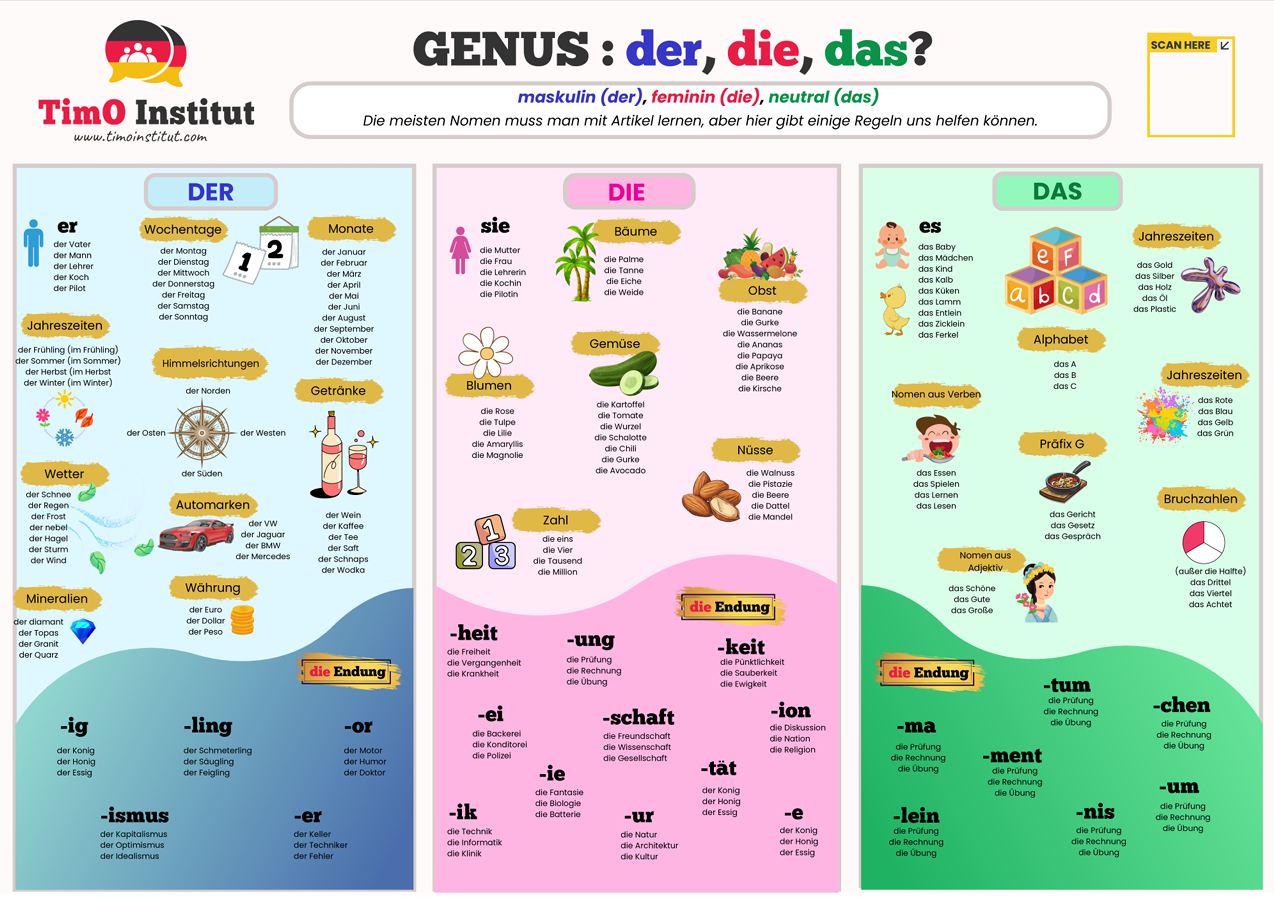
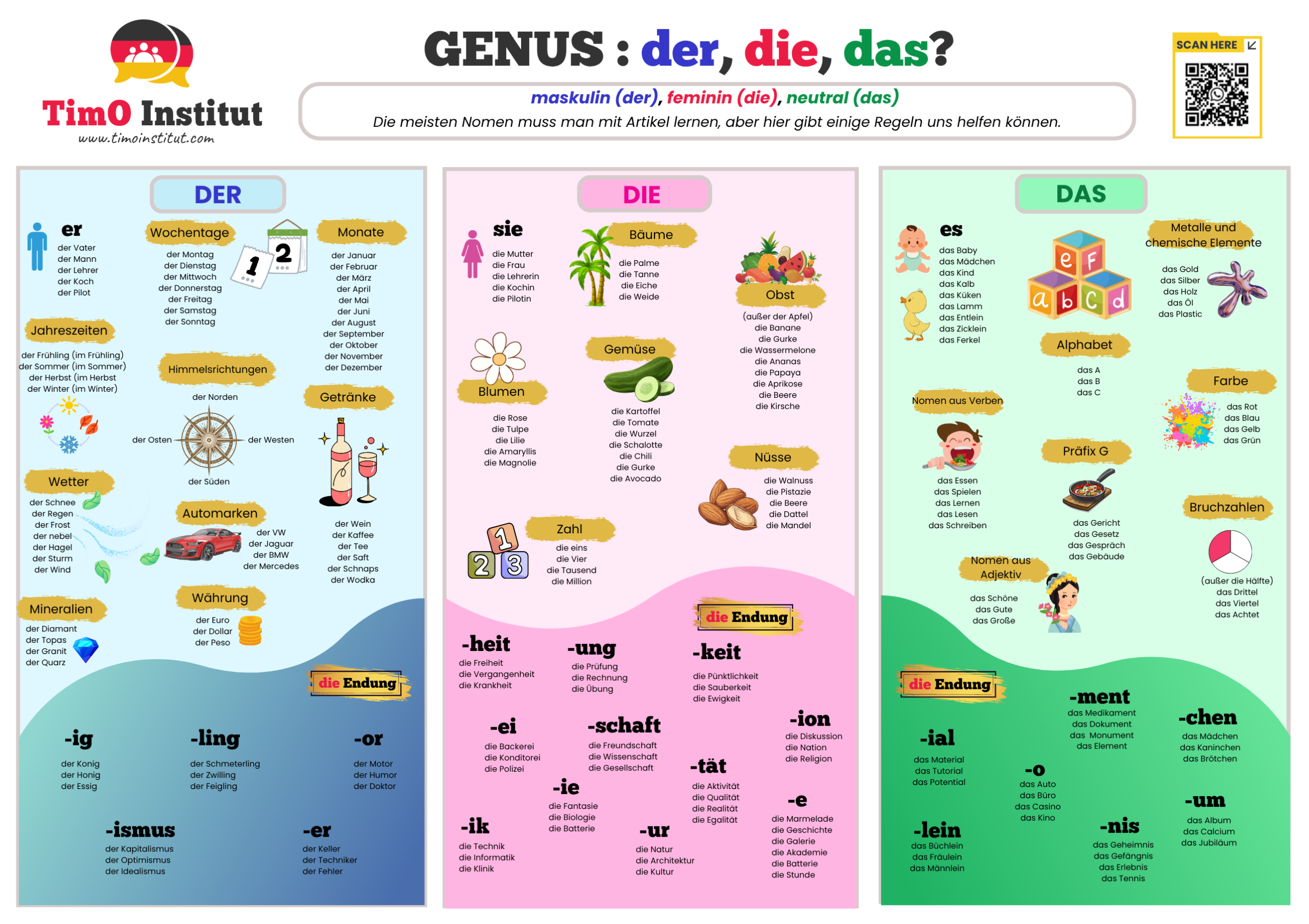
The Article der (Masculine Nouns)
Although there is no single rule that tells us whether a noun is der, die, or das, many masculine nouns belong to common categories. Learning these patterns will make it much easier to remember the correct article.
1. Male People and Professions
Most nouns referring to male people or male professions are masculine.
Examples:
- der Professor – professor
- der Vater – father
- der Lehrer – teacher
- der Arzt – doctor
2. Days of the Week
All days of the week are masculine.
Examples:
- der Montag – Monday
- der Dienstag – Tuesday
- der Mittwoch – Wednesday
- der Sonntag – Sunday
3. Times of Day
Most times of day are masculine.
Examples:
- der Morgen – morning
- der Mittag – noon
- der Nachmittag – afternoon
- der Abend – evening
4. Months
All months are masculine.
Examples:
- der Januar
- der Februar
- der März
- der Dezember
5. Seasons
All seasons are masculine.
Examples:
- der Frühling – spring
- der Sommer – summer
- der Herbst – autumn
- der Winter – winter
6. Compass Directions
The four cardinal directions are masculine.
Examples:
- der Norden – north
- der Süden – south
- der Osten – east
- der Westen – west
7. Weather Phenomena
Many weather-related nouns are masculine.
Examples:
- der Regen – rain
- der Schnee – snow
- der Wind – wind
8. Alcoholic Drinks
Most alcoholic beverages are masculine.
Examples:
- der Wein – wine
- der Wodka – vodka
- der Whisky – whisky
Exception: das Bier – beer
9. Car Brands
Most car brands are masculine when referring to the car itself.
Examples:
- der BMW
- der Mercedes
- der Volkswagen (VW)
10. Minerals and Precious Stones
Many minerals and precious stones are masculine.
Examples:
- der Diamant – diamond
- der Granit – granite
- der Marmor – marble
11. Currencies
Names of many currencies are masculine.
Examples:
- der Euro
- der Dollar
- der Yen
Masculine Nouns with Typical Endings
Besides these categories, many masculine nouns can also be recognized by their word endings (the last letters of the noun). While there are exceptions, these endings are very reliable and are worth remembering.
| Ending | Examples |
|---|---|
| -ig | der Honig (honey), der König (king) |
| -ling | der Schmetterling (butterfly), der Frühling (spring) |
| -or | der Motor (engine), der Humor (humour) |
| -ismus | der Kapitalismus (capitalism), der Idealismus (idealism) |
| -er (many, but not all) | der Computer, der Keller (basement), der Wecker (alarm clock) |
| -ant / -and | der Praktikant (intern), der Demonstrant (demonstrator) |
| -ent | der Student (student), der Absolvent (graduate) |
| -loge | der Philologe (philologist), der Graphologe (graphologist), der Biologe (biologist) |
Learning Tip
Don’t try to memorize every masculine noun individually. Instead, look for patterns.
For example:
- Is it a month? → probably der
- Is it a day of the week? → der
- Does it end in -ling? → usually der
- Does it refer to a male person or profession? → usually der
The more patterns you recognize, the easier it becomes to guess the correct article—even when you encounter a new word for the first time.
Remember: These categories are helpful guidelines, not absolute rules. German always has exceptions, but these patterns cover a large number of everyday nouns and will significantly improve your accuracy.
The Article die (Feminine Nouns)
Just like der, many feminine nouns follow recognizable patterns. These patterns won’t work every time, but they will help you remember and often guess the correct article.
1. Female People and Professions
Most nouns referring to female people or female professions are feminine.
Examples:
- die Ärztin – female doctor
- die Mutter – mother
- die Lehrerin – female teacher
- die Studentin – female student
2. Trees
Many names of trees are feminine.
Examples:
- die Palme – palm tree
- die Tanne – fir tree
- die Eiche – oak tree
- die Buche – beech tree
3. Flowers
Most flowers are feminine.
Examples:
- die Rose – rose
- die Tulpe – tulip
- die Sonnenblume – sunflower
- die Lilie – lily
4. Vegetables
Many vegetables are feminine.
Examples:
- die Gurke – cucumber
- die Tomate – tomato
- die Kartoffel – potato
- die Karotte – carrot
Note: There are exceptions, such as der Brokkoli and der Spargel.
5. Fruits
Many fruits are feminine.
Examples:
- die Kirsche – cherry
- die Banane – banana
- die Orange – orange
- die Birne – pear
6. Nuts
Most nuts are feminine.
Examples:
- die Pistazie – pistachio
- die Walnuss – walnut
- die Erdnuss – peanut
7. Numbers Used as Nouns
Numbers used as nouns are usually feminine.
Examples:
- die Eins – one
- die Vier – four
- die Tausend – thousand
- die Million – million
8. Names of Ships, Aircraft, and Motorcycles
Names of ships, aircraft, and motorcycles are usually feminine.
Examples:
- die Titanic
- die Boeing 747
- die Yamaha
- die Harley-Davidson
Feminine Nouns with Typical Endings
Many feminine nouns can also be recognized by their endings. These endings are among the most reliable clues in German.
| Ending | Examples |
|---|---|
| -heit | die Freiheit (freedom), die Krankheit (illness) |
| -keit | die Pünktlichkeit (punctuality), die Sauberkeit (cleanliness) |
| -ei | die Bäckerei (bakery), die Polizei (police) |
| -ung | die Prüfung (exam), die Übung (exercise) |
| -ik | die Technik (technology), die Informatik (computer science) |
| -ie | die Fantasie (fantasy), die Batterie (battery) |
| -ur | die Natur (nature), die Kultur (culture) |
| -schaft | die Freundschaft (friendship), die Gesellschaft (society) |
| -tät | die Universität (university), die Qualität (quality) |
| -ion | die Diskussion (discussion), die Religion (religion) |
| -e (many, but not all) | die Kanne (jug), die Halskette (necklace), die Lampe (lamp) |
| -nz | die Provinz (province), die Akzeptanz (acceptance) |
Learning Tip
When you see a noun ending in -heit, -keit, -ung, or -ion, it is almost always die.
Likewise, many nouns referring to flowers, trees, and female people are also feminine.
These patterns won’t cover every noun, but they will help you make an educated guess.
The Article das (Neuter Nouns)
Many neuter nouns also follow recognizable patterns. Some belong to specific categories, while others can be identified by their endings.
1. Letters of the Alphabet
All letters are neuter.
Examples:
- das A
- das B
- das C
- das Z
2. Young Living Creatures
Many nouns referring to young living beings are neuter.
Examples:
- das Baby – baby
- das Kind – child
- das Kalb – calf
- das Fohlen – foal
Note: das Mädchen (girl) is also neuter because it ends in -chen, not because it refers to a young person.
3. Diminutives (-chen and -lein)
All diminutives ending in -chen or -lein are neuter.
Examples:
- das Brötchen – bread roll
- das Büchlein – little book
- das Tischchen – little table
- das Blümlein – little flower
4. Metals and Chemical Elements
Most metals and chemical elements are neuter.
Examples:
- das Gold – gold
- das Silber – silver
- das Eisen – iron
- das Helium – helium
5. Colours Used as Nouns
Colours used as nouns are neuter.
Examples:
- das Grün – green
- das Blau – blue
- das Rot – red
6. Fractions
Most fractions are neuter.
Examples:
- das Drittel – one third
- das Viertel – one quarter
- das Fünftel – one fifth
Exception: die Hälfte – half
7. Nouns Beginning with Ge-
Many nouns beginning with Ge- are neuter.
Examples:
- das Gebäude – building
- das Gericht – dish / court
- das Gespräch – conversation
- das Gemüse – vegetables
Note: This is a common pattern, but there are exceptions.
8. Nouns Formed from Verbs
When a verb is used as a noun (nominalization), it is always neuter.
Examples:
- das Lesen – reading
- das Schlafen – sleeping
- das Essen – eating
- das Schwimmen – swimming
9. Nouns Formed from Adjectives
Adjectives used as nouns are often neuter when they express an abstract idea.
Examples:
- das Gute – the good
- das Schöne – the beautiful
- das Neue – the new
- das Wichtigste – the most important thing
Neuter Nouns with Typical Endings
Many neuter nouns can also be recognized by their endings.
| Ending | Examples |
|---|---|
| -ial | das Tutorial (tutorial), das Potenzial (potential) |
| -o | das Auto (car), das Kino (cinema), das Büro (office) |
| -ment | das Medikament (medicine), das Dokument (document) |
| -lein | das Büchlein (little book), das Fräulein (young lady; now old-fashioned) |
| -chen | das Brötchen (bread roll), das Tischchen (little table) |
| -nis (many, but not all) | das Erlebnis (experience), das Zeugnis (certificate), das Ergebnis (result) |
| -um | das Album (album), das Jubiläum (anniversary), das Museum (museum) |
Learning Tip
Some endings are excellent clues:
- -ung, -heit, -keit, -schaft, -ion → usually die
- -chen, -lein, -ment, -um → usually das
- -ling, -ismus, -or → usually der
You don’t need to memorize every noun individually. Instead, train yourself to notice categories and word endings. The more patterns you recognize, the more confidently you’ll be able to choose the correct article—even when you encounter a new German noun for the first time.
Remember: These patterns are guidelines, not absolute rules. German has exceptions, but these categories and endings cover a large number of everyday nouns and will make learning der, die, and das much easier.
Want to Practice der, die, das in a More Enjoyable Way?
Understanding the rules is an important first step—but the best way to make der, die, and das stick is to see them again and again in meaningful context. If you would like to strengthen your understanding of German noun genders in a fun and engaging way, I recommend reading my companion book, Der magische Spielzeugladen. Through an entertaining story, memorable characters, and plenty of everyday German nouns, the book helps you recognize the patterns behind der, die, and das naturally—without simply memorizing endless vocabulary lists.
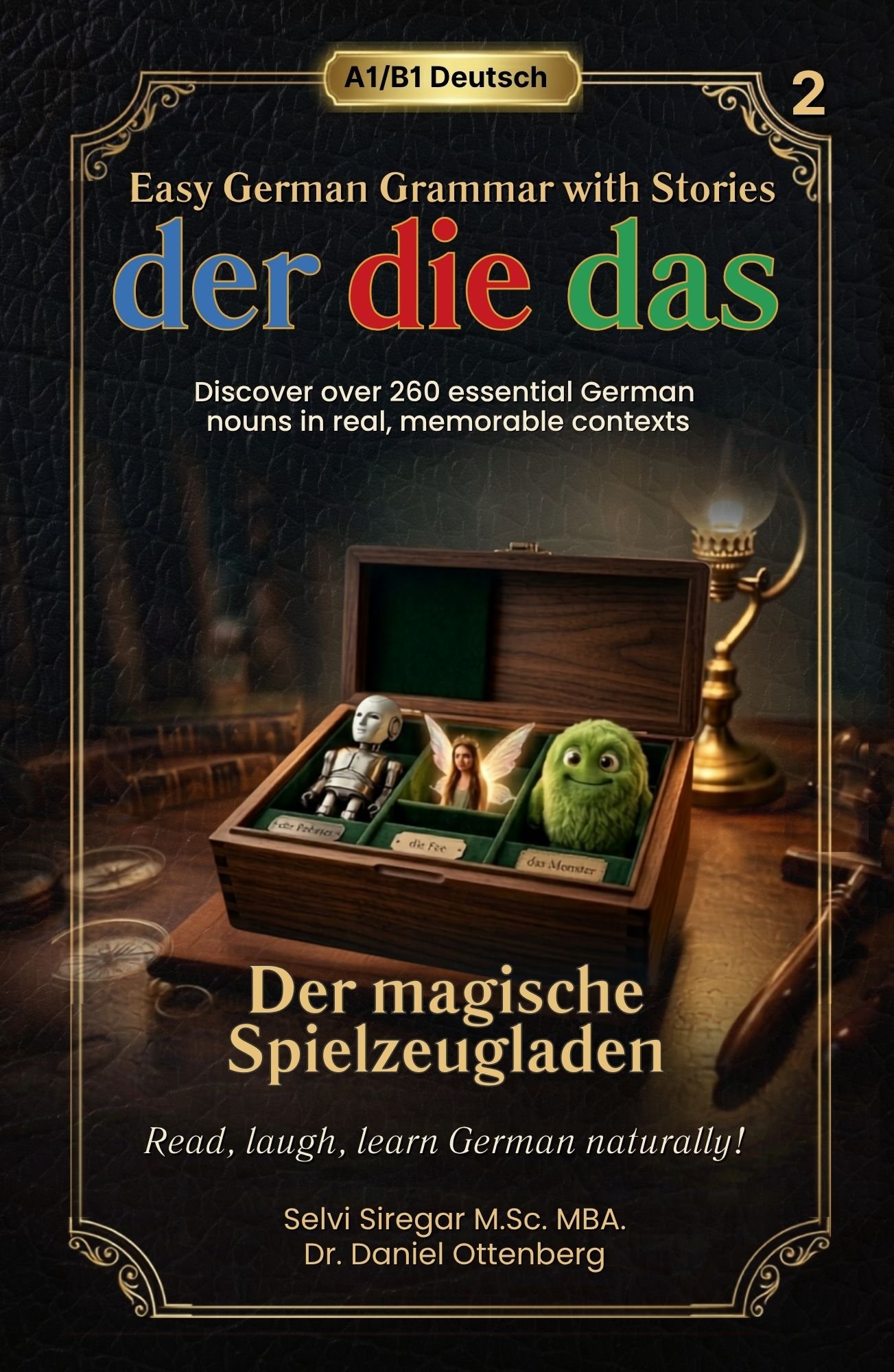
👉 Continue your learning adventure with Der magische Spielzeugladen on Amazon.de.
https://www.amazon.de/Selvi-Siregar-ebook/dp/B0HDPQQN7N
Learn the rules here. See them come alive in the story. And make der, die, das easier to remember.
0 Comments