
Connector words (Konnektoren) are words that connect two words, phrases, clauses, or sentences. They make our speaking and writing sound more natural, logical, and fluent. Instead of writing many short, separate sentences, connector words help us show how ideas are related—for example, by adding information (und..), giving a reason (weil..), showing a contrast (aber.. ), or expressing a result (deshalb..).
Although connector words are often very short, they are very important, because they influence the word order of the sentence, especially the position of the verb. For this reason, learning connector words is one of the most important steps toward speaking and writing German naturally.
To make them easier to remember, we can basically divide German connector words into four main groups.
Group 1: Normal Word Order (Normale Wortfolge)
The connector words in this group do not change the normal word order. The verb stays in its usual position.
These are the famous ADUSO connectors:
- Aber (but)
- Denn (because)
- Und (and)
- Sondern (but rather)
- Oder (or)
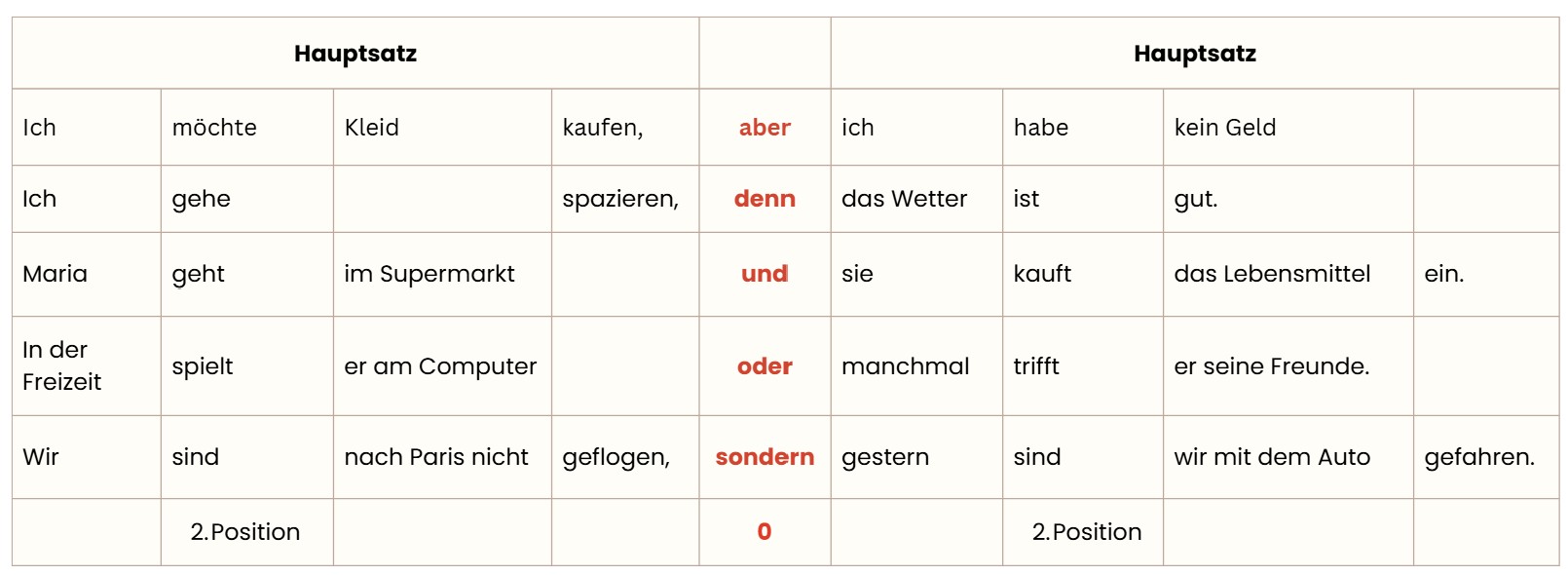
These are the easiest connector words because each sentence, keeps its normal sentence structure.
Look at the examples below:
(Notice how both sentences have normal word order. The connector word basically hold “null-position” and the konjugated verb is on second position).
Achtung!
1. Comma Rules with ADUSO Connectors
There is a comma before the connector words:
- aber
- denn
- sondern
However, there is no comma before:
- und
- oder
2. Omitting Repeated Words with ADUSO Connectors
Sometimes, the subject and the verb in the second sentence are exactly the same as in the first sentence. In this case, German often omits the repeated words to avoid sounding repetitive.
This makes the sentence shorter and more natural. Look at the examples below:
Natural sentence :
„Rock muss laut sein!“, erklärt Tobias. „Aber nicht ständig“, antwortet Kevin.
Complete sentence:
„Rock muss laut sein!“, erklärt Tobias. „Aber Rock muss nicht ständig laut sein“, antwortet Kevin.
Because Rock muss … laut sein is already clear from the first sentence, it is not necessary to repeat it.
This kind of omission is very common in everyday German, especially in conversations.
Group 2: Verb at the End (Verb am Ende des Nebensätzes)
Normally, the conjugated verb stands in the second position of a German main clause.
However, when we use the connector words in Group 2, they introduce a subordinate clause (Nebensatz). In a subordinate clause, the conjugated verb always moves to the end of the clause.
Some common connector words in this group are:
- weil (because)
- dass (that)
- obwohl (although)
- wenn (if/when)
- bevor (before)
- nachdem (after)
- während (while)
- damit (so that)
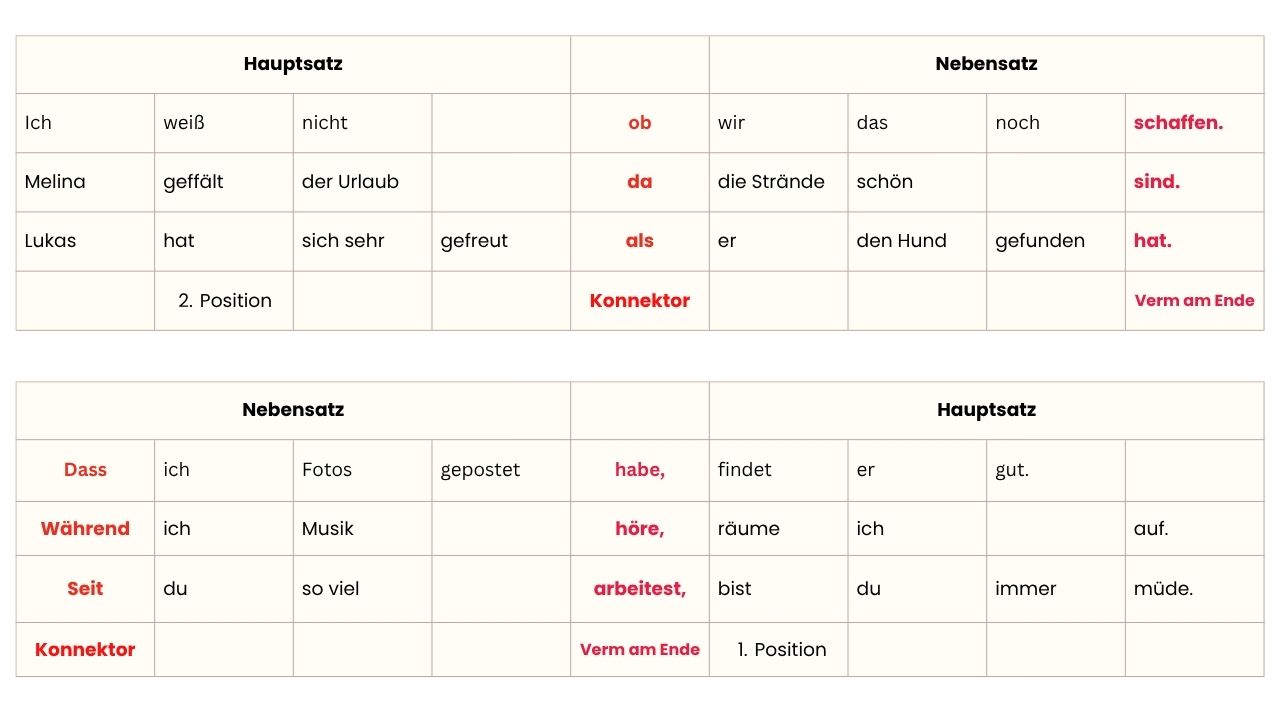
Look at the examples below:
(Notice how all the conjugated verb comes at the end of the subordinate / Nebensatz clause).
Remember
- da / weil → express a reason (because). Weil is usually put after the Hauptsazt, and da is usually put in first Position.
- obwohl → expresses a contrast (although / even though)
- Verb goes to the end of the subordinate clause.
- If the subordinate (Nebensatz) clause comes first, the main clause (Hauptsatz) begins with the verb.
Here are some more examples of Connector words in Group 2, where the conjugated verb moves to the end of the subordinate clause (Nebensatz).
- dass (that)
Ich glaube, dass Bücher unsere Allgemeinbildung erweitern. (I believe that books broaden our general knowledge.)
- weil (because)
Sie ist so traurig, weil ihr Vater gestorben ist. (She is very sad because her father has passed away.)
- da (because / since)
Da er krank war, konnte er nicht kommen. (Since he was ill, he couldn’t come.)
- obwohl (although / eventhough)
Ich rufe dich heute Abend an, obwohl wir uns morgen sehen. (I’ll call you this evening, even though we’ll see each other tomorrow.)
- damit (so that / in order that)
Schreib es dir auf, damit du es nicht wieder vergisst. (Write it down so that you don’t forget it again.)
- sodass / so …, dass (so that / as a result that)
Er war krank, sodass er absagen musste. (He was ill, so he had to cancel.)
- als (when – for a single event in the past)
Als ich 17 Jahre alt war, ist mein Vater gestorben. (When I was 17 years old, my father passed away.)
- wenn (if / when – for the present, future, or repeated events)
Sag bitte Bescheid, wenn du fertig bist! (Please let me know when you are finished!)
- bis (until)
Ich warte, bis du mit der Arbeit fertig bist. (I’ll wait until you finish your work.)
- sobald (as soon as)
Ich rufe an, sobald ich zu Hause bin. (I’ll call you as soon as I get home.)
- solange (as long as)
Du kannst spielen, solange du ruhig bist. (You can play as long as you are quiet.)
- bevore (before)
Bevor wir abreisen, müssen wir noch einiges erledigen. (Before we leave, we still have a few things to do.)
- seit / seitdem (since)
Seit sie das letzte Mal hier war, habe ich nichts mehr von ihr gehört. (Since she was here the last time, I haven’t heard from her.)
- nachdem (after)
Perfekt: Ich gehe ins Kino, nachdem ich meine Hausaufgaben erledigt habe. (I am going to the cinema after I have finished my homework.)
Plusquamperfekt: Nachdem er die Deutschprüfung bestanden hatte, begann er mit seinem Studium. (After he had passed the German exam, he began his studies.)
- indem (by / by doing something)
Ich lerne Deutsch, indem ich jeden Tag ein paar Wörter übe. (I learn German by practising a few words every day.)
Man kann Benzin sparen, indem man langsam fährt. (You can save fuel by driving slowly.)
Remember
All connector words in Group 2 introduce a subordinate clause (Nebensatz). The most important rule is:
- The conjugated verb always moves to the end of the subordinate clause.
Group 3: The Verb Comes Immediately After (Verb kommt direkt danach)
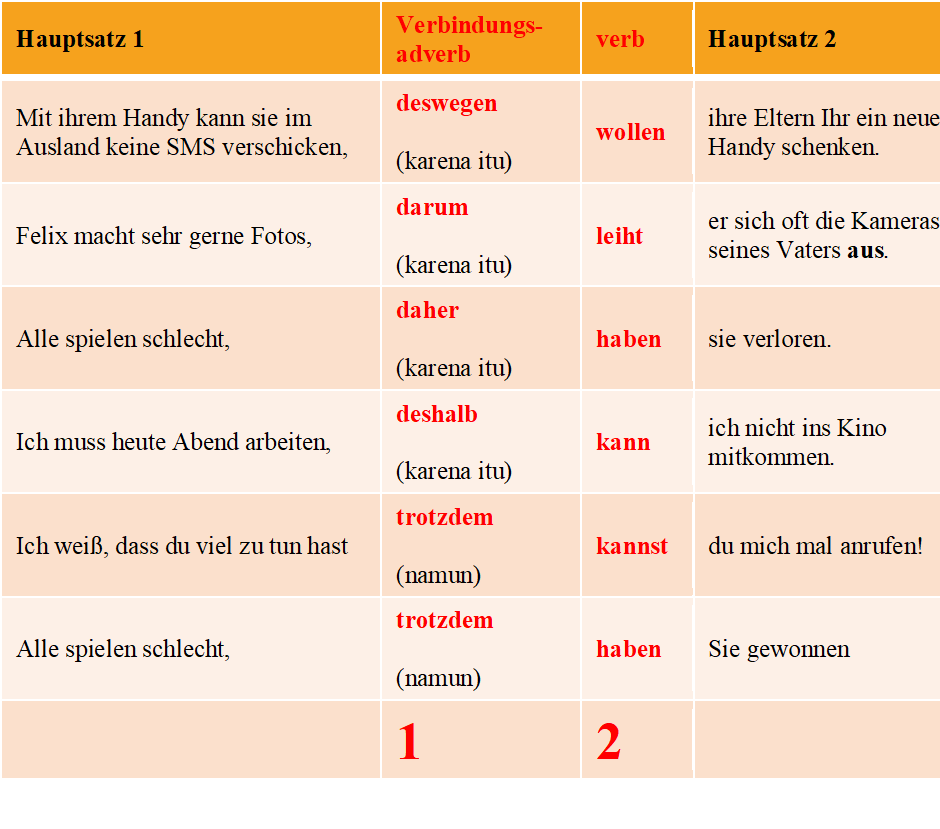
The connector words in this group connect two main clauses. When one of these connector words begins a sentence, the conjugated verb comes immediately after the connector. This means the verb appears before the subject.
This follows the German verb-second position (V2) rule: the connector occupies the first position, so the verb moves into the second position.
Some common connector words are:
- deshalb (therefore)
- darum (for that reason)
- trotzdem (nevertheless)
- dann (then)
- danach (after that)
- anschließend (afterwards)
Look at the examples below:
(Notice that the conjugated verb comes immediately after the connector word or taking the second position in the sentence)
Group 4: Double Connectors (Doppelkonnektoren)
The connector words in this group always work in pairs. One part appears before the first idea, and the second part introduces the contrasting or related idea.
Some common double connectors are:
- entweder … oder (either … or)
- sowohl … als auch (both … and)
- nicht nur … sondern auch (not only … but also)
- zwar … aber (indeed … but)
- einerseits … andererseits (on the one hand … on the other hand)
- weder … noch (neither … nor)
Look at the examples below:
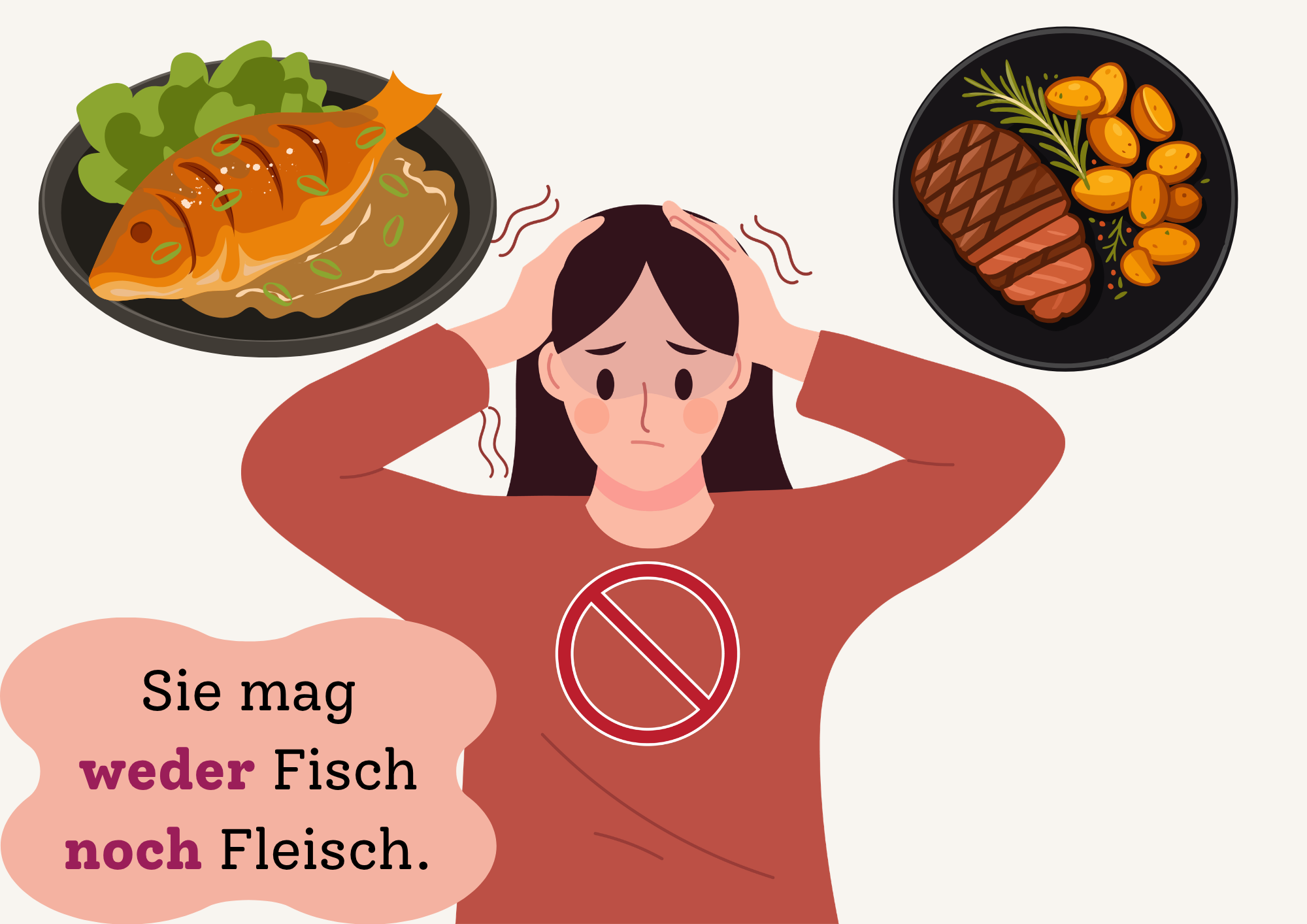
If you look at the woman’s facial expression, you can probably guess that she does not like something.
That’s right! The sentence means:
“She likes neither fish nor meat.”
The expression weder … noch … is one of the German connectors (Konnektoren). More specifically, it belongs to a special group called Double Conjunctions (Doppelte Konnektoren or Zweiteilige Konnektoren).
Unlike other conjunctions, these connectors always consist of two parts that work together. They cannot be separated or used independently. Once you use the first part, you must also use the second part.
Let’s learn the most common German double conjunctions!
1. sowohl … als auch … (both … and also …)
This conjunction is used to mention two positive facts. Both ideas are equally true.
Example:
Beim Internet kann man sowohl Zeitung lesen als auch einkaufen.
Translation:
With the Internet, people can both read newspapers and also shop online.
2. nicht nur …, sondern auch … (not only … but also …)
This conjunction is also used to mention two facts: the first fact usually use the word ‘nicht’ and the second fact gives more emphasis.
Example:
Ich spreche nicht nur Englisch, sondern auch Deutsch.
Translation:
I speak not only English, but also German.
3. entweder … oder … (either … or …)
This conjunction is used to express a choice. Only one of the two options can be chosen.
Example:
Bei der Prüfung darf man entweder einen Laptop oder ein Tablet benutzen.
Translation:
During the exam, you may use either a laptop or a tablet.
4. weder … noch … (neither … nor …)
This conjunction is used to express a negative statement about two things. Both options are rejected.
Example:
Er kann keine Ballsportarten spielen. Er kann weder Volleyball noch Fußball spielen.
Translation:
He cannot play ball sports. He can play neither volleyball nor football.
5. teils … teils … (partly … partly … / sometimes … sometimes …)
This conjunction shows that both situations occur. It is often used when something is divided between two conditions or changes from one condition to another.
Example:
Das Wetter ist im April teils sonnig, teils regnerisch.
Translation:
The weather in April is partly sunny and partly rainy.
In other words, the weather is sometimes sunny and sometimes rainy—just like the unpredictable weather during the changing seasons.
6. zwar …, aber … (it is true that … but …)
This conjunction is used when you acknowledge a fact first, but then introduce a stronger contrast or limitation.
Example:
Im Internet zu surfen ist zwar interessant, aber es kostet auch viel Zeit.
Translation:
Surfing the Internet is interesting, but it also takes a lot of time.
7. einerseits …, andererseits … (on the one hand … on the other hand …)
This conjunction is used to present two different perspectives on the same topic.
Example:
Einerseits gibt es viele Informationen im Internet, andererseits findet man auch viele falsche Informationen.
Translation:
On the one hand, there is a lot of information on the Internet. On the other hand, there is also a lot of false information.
8. je … desto / umso … (the more … the more …)
This conjunction shows a relationship between two changing situations. As one thing changes, the other changes as well. The relationship may be positive or negative.
Examples:
Je niedriger der Preis ist, desto höher wird der Umsatz.
Translation:
The lower the price is, the higher the sales become.
Je mehr Freunde sie hat, umso bekannter wird sie.
Translation:
The more friends she has, the more famous she becomes.
Remember
Double conjunctions always have two fixed parts that belong together. They cannot be separated, and each pair has its own meaning.
Learning these expressions will help you write and speak German more naturally, because native speakers use them very frequently in everyday conversations and writing.
TIPS
You do not need to memorize hundreds of grammar rules. Instead, remember these four connector groups and the word order that belongs to each one.
Once you understand these patterns, you’ll be able to build longer, more natural, and more fluent German sentences with confidence.
0 Comments